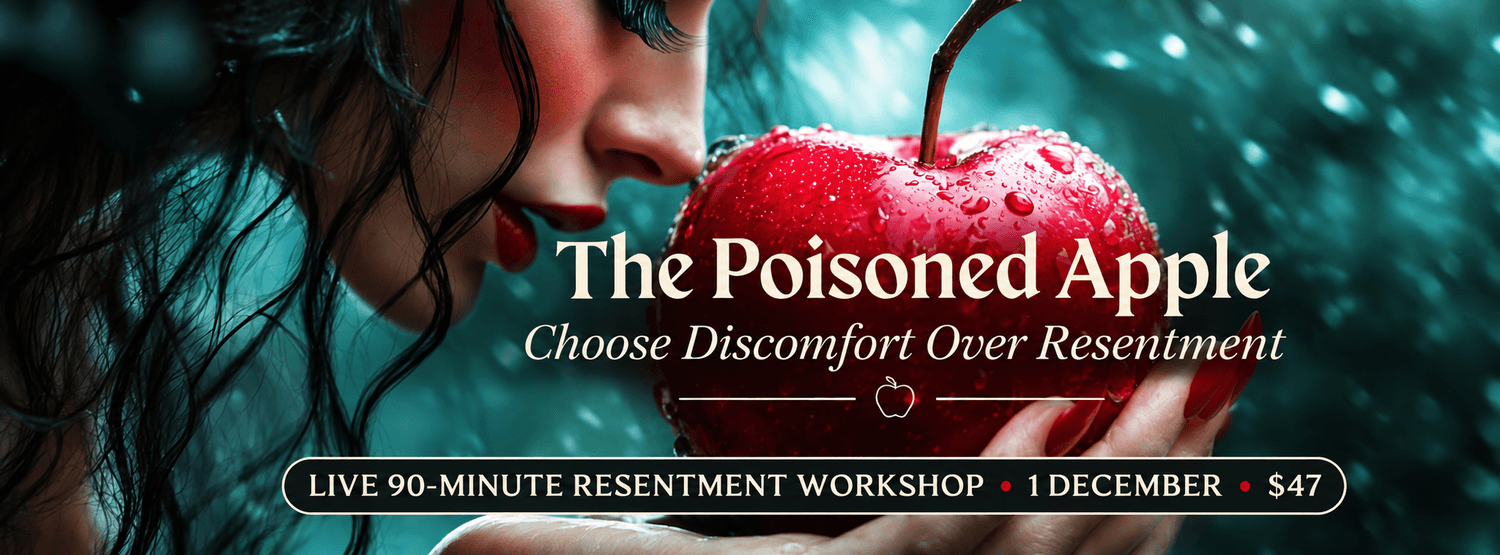
The Poisoned Apple
Because resentment costs too much.
You don't have to wait for someone else to change before you can start feeling lighter. This live 90-minute workshop helps you understand the resentment you've been carrying, recognise what's yours to change and what isn't, and start choosing the kind of discomfort that actually changes things.
You can love someone and still resent how much falls on you.
You can be tired of being the responsible one, and still struggle to let anyone else take over.
You can know something needs to change without knowing what to do about it.
And you can spend months waiting for them to finally understand, apologise or step up.
But what happens to you while you're waiting?
Maybe it looks something like this:
- You keep a quiet tally of who does what. Somehow you're always the one who's behind.
- You replay conversations in the shower, winning arguments you never actually had.
- You say "it's fine," then go cold for two days.
- Small things set you off, like the way the dishwasher gets stacked, and you know it isn't really about the dishwasher.
None of this makes you a bitter person. Resentment is information. It's telling you that something matters which hasn't been said, or hasn't been honoured.
And December, with its long family tables and longer to-do lists, has a way of bringing all of it to the surface.
It looks like goodness. That's what makes it so easy to bite.
In the garden
Eve saw that the fruit was good, pleasing to the eye and desirable. But underneath the bite was a lie about identity: that she needed something more to be enough. People-pleasing believes the same lie.
In the fairy tale
Snow White's apple was offered as a kindness, by someone who seemed harmless. It was beautiful on the outside. One bite, and she fell into a sleep so still it looked like peace. Resentment does that too. Everything looks calm on the surface, while inside you go quiet and slowly disappear from your own life.
In your life
People-pleasing looks generous. Overgiving looks loving. Holding everything together looks responsible. And when resentment comes, it feels completely justified. After everything you've done, of course you're hurt.
But a lot of what looks like serving others is quietly protecting us from something: the guilt of saying no, the risk of being disliked, the conversation we'd rather not have. It usually started as protection, and at the time it made sense. It feels selfless. Often it's avoidance, dressed up as kindness. Martyrdom has its own sweetness too. Being the one who gives the most can feel like being the good one.
For many Christian women, this apple comes wrapped in Scripture. Laying down your life. Dying to self. Turning the other cheek. Sacrifice gets praised as godliness, so saying no feels like failing God. But grace never asked you to abandon yourself. Jesus withdrew to rest, said no, and let people walk away disappointed.
"What am I getting from the very pattern I'm resenting?"
Not to blame you. To get curious. The woman who resents always being in charge is often the same woman who feels safest when she is. She wants someone to take over, then feels anxious when they do it their way.
That's why this workshop asks you to choose discomfort over resentment. The discomfort of speaking up lasts a conversation. Resentment can last years.
But we won't pretend all resentment is yours to fix. Sometimes it's pointing at behaviour that genuinely needs to change, and the other person needs to own it.
You can stop carrying resentment without taking responsibility for the behaviour that caused it.
What lighter actually looks like
You get your evenings back
Something said at breakfast doesn't run on a loop until bedtime. You notice the hurt without letting it take over your day.
Your next step stops waiting on theirs
You stop putting your life on hold until someone finally admits you were right, or gives you the apology you've been waiting for.
You know what the moment needs
Instead of "it's fine" and two days of cold silence, you can tell whether you need to speak up, set a boundary, grieve something or let it go.
You notice when you're holding on too tightly
When someone handles something differently, you start to catch the urge to supervise, correct or take over, and decide whether you actually need to.
Lighter doesn't mean accepting what isn't okay. It means you stop carrying it alone, and start responding to it with clarity.
What you'll walk away with
What resentment really is
You'll see the difference between anger, disappointment and resentment, and why some hurts fade while others keep replaying.
Mine, yours and ours
You'll spot the agreements you've made that nobody else knows about, and separate what's yours to carry from what you've picked up on someone else's behalf.
The hidden payoff
You'll recognise what the pattern gives you, whether that's safety, worth or control, so letting go stops feeling like losing yourself.
The discomfort you've been avoiding
Why saying no, disappointing someone or letting them do it their way feels so hard, and how to stay steady in yourself while someone else is unhappy. You'll also learn to tell healthy discomfort apart from a situation that isn't safe.
A guided release
A meditation, live with me, to put down what isn't yours. You'll also notice what you're not ready to release yet, without judging yourself for it.
What remains
You'll leave with a clearer idea of what your resentment is asking of you next. A conversation you've been avoiding, a responsibility you need to hand back, a boundary to put in place, or something you need time to grieve. Some of it may need accountability from someone else, and you'll be able to tell when inner work alone isn't the answer.
The Antidote
A simple practice for the next time resentment flares. You'll learn to notice where it lands in your body, ask whose it is and what it's asking for, and choose a response instead of swallowing it or letting it run your evening.
Live Q&A
Bring your real situation, ask your questions and get answers in the moment.
Resentment isn't something you simply get rid of. It's something to understand, respond to and learn from.
You probably already know why you're resentful.
You know you take on too much. You know you need better boundaries. You've probably got a good idea of where some of these patterns started. Maybe you've even asked ChatGPT or Claude about it and got a genuinely helpful answer.
But knowing hasn't changed how you feel when someone is disappointed in you. Or how quickly you step in when something isn't being done your way.
Knowing what to do and being able to do it while your body is flooded with guilt or anxiety are two different things. That gap is what this workshop is for.
- You work with your own situation. Not a general explanation of resentment, but the specific pattern you keep repeating and what's holding it in place.
- Someone who won't just take your side. AI tends to agree with whoever is typing. Real change usually starts with a question you wouldn't have asked yourself, like what you might be getting from the pattern you resent.
- An experience, not an explanation. The guided release happens in your body, in real time, with a voice guiding you through it. Reading about letting go isn't the same as doing it.
- Other women in the room. Hearing your exact situation in someone else's question tells you that you're not the only one.
- More than 20 years of clinical judgement. Knowing when something isn't resentment work at all, and needs something else.
Understanding a pattern and changing it aren't the same thing. This is where you start changing it.
Come into the holidays lighter, not bracing for them.
This is the month resentment pulls up a chair. Long weekends with family, full tables, and the quiet tally of who did the shopping, the cooking and the remembering. You can walk into it with a different response ready.
- The 90-minute live workshop on ZoomTeaching, the guided release, and The Antidote practice for when resentment flares again
- Live Q&A with TehillaBring your own situation
- The Poisoned Apple workbookThe mine, yours and ours exercise, reflection prompts for after the meditation, a guide to what your remaining resentment needs, and The Antidote on one page to keep where you'll see it
- The replayYours for as long as the workshop is available
Tuesday 1 December 2026
7pm South Africa · 5pm UK
12pm US Eastern · 9am US Pacific
USD, one-time payment
Save my seatCan't make it live? Register anyway. The replay and workbook will be waiting for you.
Is this for you?
This is for you if
- You're tired of being the one who remembers, plans and holds everything together
- You love the people you feel resentful toward and don't want to lose them
- You've tried to "just let it go" and it keeps coming back
- You're waiting for someone to change, and tired of putting your life on hold until they do
- It's not only your partner. It's your mother, your sister, a friend or a colleague
This isn't for you if
- You're looking for a script to make someone else change
- You need therapy or crisis support right now
- You don't feel safe in your relationship. Please reach out to a professional near you first. Your safety matters more than any workshop.
Tehilla Luttig
Rooted in grace. Trained in psychology.
I've been sitting with people in the middle of their relationships since 2013, first as a registered counsellor in private practice and now as a relationship and identity coach working with clients around the world.
I'm trained in the Gottman Method, BWRT and Discernment Counselling, and I don't work from a single model. People are layered, and so is the work.
Resentment is one of the most common things I see, and one of the most misunderstood. It's rarely about the dishes. More often it's about identity: who you learned you had to be in order to be loved, and what it costs you to keep being her.
The Poisoned Apple is a coaching and education workshop, not therapy.

Questions
What if they never change?
This workshop isn't about whether they change or not. It's about understanding your resentment and what it's trying to tell you. You'll leave with a clearer sense of what you need to do next, whether that's a boundary, an honest conversation or a bigger decision. It won't tell you to stay or to go. It helps you stop putting your own life on hold while you wait.
Does my partner need to attend?
No, and for this workshop I'd actually ask you to come on your own. Resentment tends to put defences up, and I want this to be an open, safe space where you can be honest about what you're carrying.
Is this only about romantic relationships?
The focus is mostly on romantic relationships, and most of the examples come from there. But you can use what you learn with parents, siblings, friends and colleagues too.
What if I can't attend live?
Register anyway. You'll receive the replay and the workbook, and you can watch for as long as the workshop is available.
Will I have to share or be on camera?
No, your camera is optional. I do love it when cameras are on, because seeing your faces tells me when to slow down, speed up or pause for a question. It really guides the session. The more you participate, the more you tend to get out of it, but you're welcome to simply listen. Often the women who arrive feeling shy find it's a safe space, and end up wanting to talk.
Is this therapy?
No. It's a coaching and education workshop. If you need therapy or crisis support, please reach out to a professional near you.
I have another question
Email me at hello@tehillaluttig.com and I'll get back to you.